National Gallery of Art Renaissance to Impressionism Art 25 Kvã›tna

Impressionism is a 19th-century fine art movement characterized by relatively small, sparse, yet visible brush strokes, open composition, accent on accurate depiction of light in its changing qualities (often accentuating the furnishings of the passage of fourth dimension), ordinary subject matter, unusual visual angles, and inclusion of movement as a crucial element of human perception and experience. Impressionism originated with a grouping of Paris-based artists whose independent exhibitions brought them to prominence during the 1870s and 1880s.
The Impressionists faced harsh opposition from the conventional art community in France. The name of the style derives from the title of a Claude Monet work, Impression, soleil levant (Impression, Sunrise), which provoked the critic Louis Leroy to coin the term in a satirical review published in the Parisian paper Le Charivari. The development of Impressionism in the visual arts was soon followed by analogous styles in other media that became known equally impressionist music and impressionist literature.
Overview [edit]

Radicals in their fourth dimension, early Impressionists violated the rules of bookish painting. They synthetic their pictures from freely brushed colours that took precedence over lines and contours, following the example of painters such as Eugène Delacroix and J. M. Westward. Turner. They also painted realistic scenes of mod life, and often painted outdoors. Previously, however lifes and portraits likewise as landscapes were usually painted in a studio.[one] The Impressionists establish that they could capture the momentary and transient effects of sunlight by painting outdoors or en plein air. They portrayed overall visual effects instead of details, and used short "broken" castor strokes of mixed and pure unmixed colour—not composite smoothly or shaded, as was customary—to achieve an event of intense colour vibration.

Impressionism emerged in France at the same time that a number of other painters, including the Italian artists known as the Macchiaioli, and Winslow Homer in the United states, were as well exploring plein-air painting. The Impressionists, yet, developed new techniques specific to the style. Encompassing what its adherents argued was a dissimilar way of seeing, it is an art of immediacy and movement, of aboveboard poses and compositions, of the play of calorie-free expressed in a bright and varied use of colour.
The public, at starting time hostile, gradually came to believe that the Impressionists had captured a fresh and original vision, fifty-fifty if the art critics and art establishment disapproved of the new style. By recreating the sensation in the eye that views the subject, rather than delineating the details of the subject area, and past creating a welter of techniques and forms, Impressionism is a precursor of various painting styles, including Neo-Impressionism, Postal service-Impressionism, Fauvism, and Cubism.
Beginnings [edit]
In the middle of the 19th century—a time of change, as Emperor Napoleon Three rebuilt Paris and waged war—the Académie des Beaux-Arts dominated French art. The Académie was the preserver of traditional French painting standards of content and style. Historical subjects, religious themes, and portraits were valued; landscape and even so life were non. The Académie preferred carefully finished images that looked realistic when examined closely. Paintings in this fashion were made up of precise brush strokes carefully blended to hide the artist's hand in the work.[iii] Colour was restrained and often toned down further past the application of a golden varnish.[4]
The Académie had an annual, juried art prove, the Salon de Paris, and artists whose work was displayed in the show won prizes, garnered commissions, and enhanced their prestige. The standards of the juries represented the values of the Académie, represented by the works of such artists every bit Jean-Léon Gérôme and Alexandre Cabanel.
In the early 1860s, 4 young painters—Claude Monet, Pierre-Auguste Renoir, Alfred Sisley, and Frédéric Bazille—met while studying under the bookish creative person Charles Gleyre. They discovered that they shared an involvement in painting landscape and gimmicky life rather than historical or mythological scenes. Following a do that had go increasingly popular past mid-century, they often ventured into the countryside together to pigment in the open air,[v] but not for the purpose of making sketches to be developed into advisedly finished works in the studio, as was the usual custom.[6] Past painting in sunlight direct from nature, and making assuming employ of the vivid synthetic pigments that had become available since the beginning of the century, they began to develop a lighter and brighter manner of painting that extended further the Realism of Gustave Courbet and the Barbizon school. A favourite meeting place for the artists was the Café Guerbois on Artery de Clichy in Paris, where the discussions were oftentimes led by Édouard Manet, whom the younger artists greatly admired. They were soon joined past Camille Pissarro, Paul Cézanne, and Armand Guillaumin.[vii]

During the 1860s, the Salon jury routinely rejected about half of the works submitted by Monet and his friends in favour of works by artists faithful to the approved manner.[8] In 1863, the Salon jury rejected Manet's The Luncheon on the Grass (Le déjeuner sur l'herbe) primarily because it depicted a nude woman with ii clothed men at a picnic. While the Salon jury routinely accepted nudes in historical and allegorical paintings, they condemned Manet for placing a realistic nude in a contemporary setting.[ix] The jury'southward severely worded rejection of Manet'southward painting appalled his admirers, and the unusually large number of rejected works that year perturbed many French artists.
After Emperor Napoleon III saw the rejected works of 1863, he decreed that the public be allowed to judge the work themselves, and the Salon des Refusés (Salon of the Refused) was organized. While many viewers came but to laugh, the Salon des Refusés drew attention to the being of a new trend in art and attracted more visitors than the regular Salon.[x]

Artists' petitions requesting a new Salon des Refusés in 1867, and once more in 1872, were denied. In December 1873, Monet, Renoir, Pissarro, Sisley, Cézanne, Berthe Morisot, Edgar Degas and several other artists founded the Société Anonyme Coopérative des Artistes Peintres, Sculpteurs, Graveurs ("Cooperative and Anonymous Association of Painters, Sculptors, and Engravers") to exhibit their artworks independently.[11] Members of the association were expected to forswear participation in the Salon.[12] The organizers invited a number of other progressive artists to join them in their inaugural exhibition, including the older Eugène Boudin, whose case had first persuaded Monet to prefer plein air painting years before.[13] Another painter who greatly influenced Monet and his friends, Johan Jongkind, declined to participate, as did Édouard Manet. In total, xxx artists participated in their showtime exhibition, held in April 1874 at the studio of the lensman Nadar.
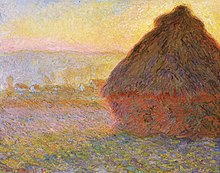
The critical response was mixed. Monet and Cézanne received the harshest attacks. Critic and humorist Louis Leroy wrote a scathing review in the newspaper Le Charivari in which, making wordplay with the title of Claude Monet's Impression, Sunrise (Impression, soleil levant), he gave the artists the proper name by which they became known. Derisively titling his commodity The Exhibition of the Impressionists, Leroy declared that Monet'southward painting was at most, a sketch, and could inappreciably be termed a finished work.
He wrote, in the form of a dialogue between viewers,
- "Impression—I was sure of information technology. I was just telling myself that, since I was impressed, in that location had to exist some impression in it ... and what freedom, what ease of workmanship! Wallpaper in its embryonic state is more finished than that seascape."[14]
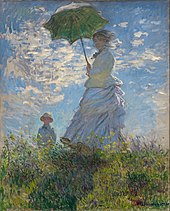
The term Impressionist quickly gained favour with the public. It was also accepted past the artists themselves, even though they were a diverse group in style and temperament, unified primarily by their spirit of independence and rebellion. They exhibited together—albeit with shifting membership—eight times between 1874 and 1886. The Impressionists' way, with its loose, spontaneous brushstrokes, would soon become synonymous with modern life.[iv]
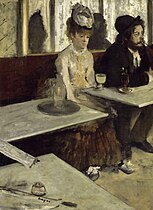
Monet, Sisley, Morisot, and Pissarro may be considered the "purest" Impressionists, in their consistent pursuit of an art of spontaneity, sunlight, and color. Degas rejected much of this, every bit he believed in the primacy of cartoon over colour and belittled the practice of painting outdoors.[15] Renoir turned away from Impressionism for a time during the 1880s, and never entirely regained his delivery to its ideas. Édouard Manet, although regarded past the Impressionists equally their leader,[xvi] never abandoned his liberal use of black as a color (while Impressionists avoided its use and preferred to obtain darker colours by mixing), and never participated in the Impressionist exhibitions. He continued to submit his works to the Salon, where his painting Castilian Singer had won a 2nd class medal in 1861, and he urged the others to do likewise, arguing that "the Salon is the real field of boxing" where a reputation could be made.[17]

Amidst the artists of the cadre group (minus Bazille, who had died in the Franco-Prussian War in 1870), defections occurred as Cézanne, followed later by Renoir, Sisley, and Monet, abstained from the group exhibitions so they could submit their works to the Salon. Disagreements arose from problems such as Guillaumin's membership in the group, championed past Pissarro and Cézanne against opposition from Monet and Degas, who thought him unworthy.[18] Degas invited Mary Cassatt to brandish her work in the 1879 exhibition, but too insisted on the inclusion of Jean-François Raffaëlli, Ludovic Lepic, and other realists who did not represent Impressionist practices, causing Monet in 1880 to accuse the Impressionists of "opening doors to offset-come daubers".[19] The group divided over invitations to Paul Signac and Georges Seurat to showroom with them in 1886. Pissarro was the only creative person to show at all eight Impressionist exhibitions.
The individual artists achieved few financial rewards from the Impressionist exhibitions, but their art gradually won a caste of public acceptance and support. Their dealer, Durand-Ruel, played a major role in this every bit he kept their work before the public and arranged shows for them in London and New York. Although Sisley died in poverty in 1899, Renoir had a nifty Salon success in 1879.[20] Monet became secure financially during the early 1880s and and so did Pissarro past the early 1890s. Past this fourth dimension the methods of Impressionist painting, in a diluted form, had become commonplace in Salon art.[21]
Impressionist techniques [edit]
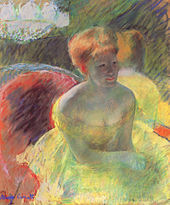
Mary Cassatt, Lydia Leaning on Her Arms (in a theatre box), 1879
French painters who prepared the style for Impressionism include the Romantic colourist Eugène Delacroix, the leader of the realists Gustave Courbet, and painters of the Barbizon school such equally Théodore Rousseau. The Impressionists learned much from the work of Johan Barthold Jongkind, Jean-Baptiste-Camille Corot and Eugène Boudin, who painted from nature in a direct and spontaneous fashion that prefigured Impressionism, and who befriended and advised the younger artists.
A number of identifiable techniques and working habits contributed to the innovative fashion of the Impressionists. Although these methods had been used past previous artists—and are often conspicuous in the work of artists such as Frans Hals, Diego Velázquez, Peter Paul Rubens, John Lawman, and J. M. W. Turner—the Impressionists were the first to use them all together, and with such consistency. These techniques include:
- Short, thick strokes of paint chop-chop capture the essence of the field of study, rather than its details. The paint is ofttimes applied impasto.
- Colours are applied side by side with as little mixing as possible, a technique that exploits the principle of simultaneous contrast to make the colour announced more than bright to the viewer.
- Greys and dark tones are produced past mixing complementary colours. Pure impressionism avoids the utilize of blackness pigment.
- Wet paint is placed into wet paint without waiting for successive applications to dry, producing softer edges and intermingling of color.
- Impressionist paintings do not exploit the transparency of thin paint films (glazes), which before artists manipulated carefully to produce furnishings. The impressionist painting surface is typically opaque.
- The pigment is practical to a white or light-coloured footing. Previously, painters ofttimes used dark grey or strongly coloured grounds.
- The play of natural light is emphasized. Close attention is paid to the reflection of colours from object to object. Painters often worked in the evening to produce effets de soir—the shadowy furnishings of evening or twilight.
- In paintings fabricated en plein air (outdoors), shadows are boldly painted with the blue of the sky equally it is reflected onto surfaces, giving a sense of freshness previously non represented in painting. (Bluish shadows on snow inspired the technique.)
New technology played a role in the development of the mode. Impressionists took advantage of the mid-century introduction of premixed paints in tin tubes (resembling modern toothpaste tubes), which allowed artists to work more spontaneously, both outdoors and indoors.[22] Previously, painters fabricated their own paints individually, by grinding and mixing dry pigment powders with linseed oil, which were then stored in beast bladders.[23]
Many vivid constructed pigments became commercially available to artists for the first time during the 19th century. These included cobalt blue, viridian, cadmium yellowish, and synthetic ultramarine blue, all of which were in use by the 1840s, before Impressionism.[24] The Impressionists' mode of painting made assuming apply of these pigments, and of even newer colours such every bit cerulean bluish,[4] which became commercially bachelor to artists in the 1860s.[24]
The Impressionists' progress toward a brighter style of painting was gradual. During the 1860s, Monet and Renoir sometimes painted on canvases prepared with the traditional ruddy-brownish or greyness ground.[25] Past the 1870s, Monet, Renoir, and Pissarro usually chose to paint on grounds of a lighter grey or beige colour, which functioned as a middle tone in the finished painting.[25] Past the 1880s, some of the Impressionists had come to adopt white or slightly off-white grounds, and no longer immune the footing color a significant function in the finished painting.[26]
Content and composition [edit]
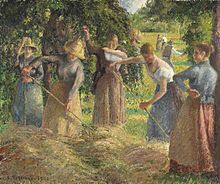
Prior to the Impressionists, other painters, notably such 17th-century Dutch painters every bit Jan Steen, had emphasized mutual subjects, just their methods of composition were traditional. They bundled their compositions so that the main subject field commanded the viewer's attention. J. M. W. Turner, while an artist of the Romantic era, anticipated the style of impressionism with his artwork.[27] The Impressionists relaxed the boundary between field of study and background so that the result of an Impressionist painting often resembles a snapshot, a part of a larger reality captured equally if by chance.[28] Photography was gaining popularity, and every bit cameras became more portable, photographs became more than candid. Photography inspired Impressionists to represent momentary action, not only in the fleeting lights of a landscape, simply in the day-to-mean solar day lives of people.[29] [30]
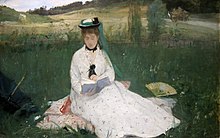
The development of Impressionism can be considered partly as a reaction past artists to the claiming presented by photography, which seemed to devalue the artist'southward skill in reproducing reality. Both portrait and landscape paintings were accounted somewhat deficient and lacking in truth equally photography "produced lifelike images much more efficiently and reliably".[31]
In spite of this, photography actually inspired artists to pursue other means of creative expression, and rather than compete with photography to emulate reality, artists focused "on the 1 matter they could inevitably practise better than the photo—past farther developing into an fine art form its very subjectivity in the formulation of the image, the very subjectivity that photography eliminated".[31] The Impressionists sought to express their perceptions of nature, rather than create verbal representations. This allowed artists to depict subjectively what they saw with their "tacit imperatives of taste and censor".[32] Photography encouraged painters to exploit aspects of the painting medium, similar colour, which photography then lacked: "The Impressionists were the commencement to consciously offering a subjective alternative to the photo".[31]
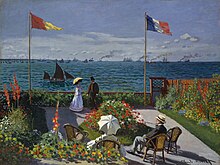
Another major influence was Japanese ukiyo-due east art prints (Japonism). The art of these prints contributed significantly to the "snapshot" angles and anarchistic compositions that became characteristic of Impressionism. An example is Monet's Jardin à Sainte-Adresse, 1867, with its bold blocks of colour and composition on a strong diagonal slant showing the influence of Japanese prints.[34]
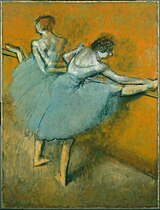
Edgar Degas was both an avid photographer and a collector of Japanese prints.[35] His The Dance Grade (La classe de danse) of 1874 shows both influences in its asymmetrical composition. The dancers are seemingly caught off guard in various awkward poses, leaving an expanse of empty flooring space in the lower right quadrant. He also captured his dancers in sculpture, such as the Footling Dancer of Fourteen Years.
Women Impressionists [edit]
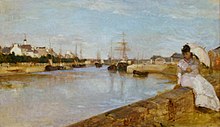
Impressionists, in varying degrees, were looking for ways to depict visual experience and contemporary subjects.[36] Women Impressionists were interested in these same ethics but had many social and career limitations compared to male Impressionists. In particular, they were excluded from the imagery of the bourgeois social sphere of the boulevard, cafe, and dance hall.[37] As well as imagery, women were excluded from the determinative discussions that resulted in meetings in those places; that was where male Impressionists were able to grade and share ideas about Impressionism.[37] In the academic realm, women were believed to be incapable of handling complex subjects which led teachers to restrict what they taught female students.[38] It was also considered unladylike to excel in art since women's true talents were then believed to center on homemaking and mothering.[38]
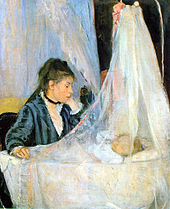
All the same several women were able to notice success during their lifetime, even though their careers were affected past personal circumstances – Bracquemond, for example, had a husband who was resentful of her work which caused her to give upward painting.[39] The four almost well known, namely, Mary Cassatt, Eva Gonzalès, Marie Bracquemond, and Berthe Morisot, are, and were, ofttimes referred to as the 'Women Impressionists'. Their participation in the serial of eight Impressionist exhibitions that took place in Paris from 1874 to 1886 varied: Morisot participated in seven, Cassatt in 4, Bracquemond in three, and Gonzalès did not participate.[39] [twoscore]
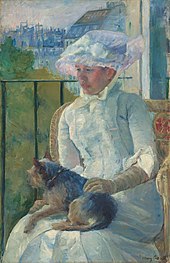
The critics of the time lumped these iv together without regard to their personal styles, techniques, or subject matter.[41] Critics viewing their works at the exhibitions often attempted to acknowledge the women artists' talents but circumscribed them within a express notion of femininity.[42] Arguing for the suitability of Impressionist technique to women'south manner of perception, Parisian critic S.C. de Soissons wrote:
Ane can empathise that women have no originality of thought, and that literature and music have no feminine graphic symbol; only surely women know how to observe, and what they run across is quite different from that which men run into, and the art which they put in their gestures, in their toilet, in the decoration of their surroundings is sufficient to give is the idea of an instinctive, of a peculiar genius which resides in each i of them.[43]
While Impressionism legitimized the domestic social life as subject affair, of which women had intimate knowledge, it also tended to limit them to that subject area matter. Portrayals of often-identifiable sitters in domestic settings (which could offer commissions) were dominant in the exhibitions.[44] The subjects of the paintings were oftentimes women interacting with their environs by either their gaze or movement. Cassatt, in particular, was aware of her placement of subjects: she kept her predominantly female figures from objectification and cliche; when they are not reading, they converse, run up, drink tea, and when they are inactive, they seem lost in idea.[45]
The women Impressionists, like their male counterparts, were striving for "truth," for new ways of seeing and new painting techniques; each creative person had an private painting style.[46] Women Impressionists (peculiarly Morisot and Cassatt) were conscious of the remainder of ability between women and objects in their paintings – the conservative women depicted are not defined by decorative objects, only instead, interact with and boss the things with which they live.[47] In that location are many similarities in their depictions of women who seem both at ease and subtly confined.[48] Gonzalès' Box at the Italian Opera depicts a woman staring into the distance, at ease in a social sphere merely confined by the box and the human being continuing next to her. Cassatt'south painting Young Daughter at a Window is brighter in color but remains constrained by the canvas edge as she looks out the window.
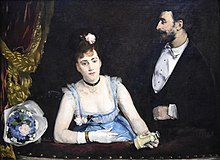
Despite their success in their power to have a career and Impressionism's demise attributed to its allegedly feminine characteristics (its sensuality, dependence on sensation, physicality, and fluidity) the 4 women artists (and other, lesser-known women Impressionists) were largely omitted from art historical textbooks covering Impressionist artists until Tamar Garb'southward Women Impressionists published in 1986.[49] For example, Impressionism by Jean Leymarie, published in 1955 included no information on any women Impressionists.
Master Impressionists [edit]
The central figures in the development of Impressionism in France,[fifty] [51] listed alphabetically, were:
- Frédéric Bazille (1841–1870), who simply posthumously participated in the Impressionist exhibitions
- Gustave Caillebotte (1848–1894), who, younger than the others, joined forces with them in the mid-1870s
- Mary Cassatt (1844–1926), American-born, she lived in Paris and participated in iv Impressionist exhibitions
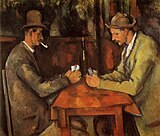
- Paul Cézanne (1839–1906), although he subsequently broke away from the Impressionists
- Edgar Degas (1834–1917), who despised the term Impressionist
- Armand Guillaumin (1841–1927)
- Édouard Manet (1832–1883), who did not participate in any of the Impressionist exhibitions[52]
- Claude Monet (1840–1926), the most prolific of the Impressionists and the one who embodies their aesthetic nigh manifestly[53]
- Berthe Morisot (1841–1895) who participated in all Impressionist exhibitions except in 1879
- Camille Pissarro (1830–1903)
- Pierre-Auguste Renoir (1841–1919), who participated in Impressionist exhibitions in 1874, 1876, 1877 and 1882
- Alfred Sisley (1839–1899)
Gallery [edit]






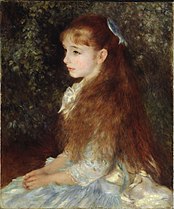


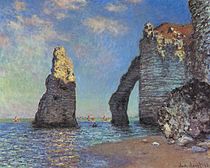


Timeline: Lives of the Impressionists [edit]
The Impressionists

Associates and influenced artists [edit]
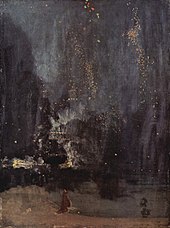
Among the close assembly of the Impressionists were several painters who adopted their methods to some degree. These include Jean-Louis Forain (who participated in Impressionist exhibitions in 1879, 1880, 1881 and 1886)[54] and Giuseppe De Nittis, an Italian artist living in Paris who participated in the first Impressionist exhibit at the invitation of Degas, although the other Impressionists disparaged his work.[55] Federico Zandomeneghi was another Italian friend of Degas who showed with the Impressionists. Eva Gonzalès was a follower of Manet who did not exhibit with the grouping. James Abbott McNeill Whistler was an American-built-in painter who played a office in Impressionism although he did not join the group and preferred grayed colours. Walter Sickert, an English language artist, was initially a follower of Whistler, and later an important disciple of Degas; he did not showroom with the Impressionists. In 1904 the creative person and author Wynford Dewhurst wrote the first important report of the French painters published in English, Impressionist Painting: its genesis and development, which did much to popularize Impressionism in Dandy United kingdom.
By the early 1880s, Impressionist methods were affecting, at least superficially, the art of the Salon. Fashionable painters such every bit Jean Béraud and Henri Gervex plant disquisitional and financial success by brightening their palettes while retaining the smooth finish expected of Salon art.[56] Works by these artists are sometimes casually referred to as Impressionism, despite their remoteness from Impressionist practice.
The influence of the French Impressionists lasted long subsequently near of them had died. Artists like J.D. Kirszenbaum were borrowing Impressionist techniques throughout the twentieth century.
Beyond France [edit]

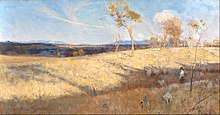
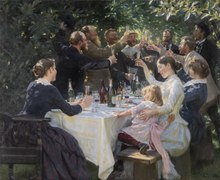
Equally the influence of Impressionism spread across France, artists, too numerous to list, became identified every bit practitioners of the new manner. Some of the more important examples are:
- The American Impressionists, including Mary Cassatt, William Merritt Chase, Frederick Carl Frieseke, Childe Hassam, Willard Metcalf, Lilla Cabot Perry, Theodore Robinson, Edmund Charles Tarbell, John Henry Twachtman, Catherine Wiley and J. Alden Weir.
- The Australian Impressionists, including Tom Roberts, Arthur Streeton, Walter Withers, Charles Conder and Frederick McCubbin (who were prominent members of the Heidelberg Schoolhouse), and John Russell, a friend of Van Gogh, Rodin, Monet and Matisse.
- The Amsterdam Impressionists in the Netherlands, including George Hendrik Breitner, Isaac Israëls, Willem Bastiaan Tholen, Willem de Zwart, Willem Witsen and Jan Toorop.
- Anna Boch, Vincent van Gogh's friend Eugène Boch, Georges Lemmen and Théo van Rysselberghe, Impressionist painters from Kingdom of belgium.
- Ivan Grohar, Rihard Jakopič, Matija Jama, and Matej Sternen, Impressionists from Slovenia. Their beginning was in the school of Anton Ažbe in Munich and they were influenced by Jurij Šubic and Ivana Kobilca, Slovene painters working in Paris.
- Wynford Dewhurst, Walter Richard Sickert, and Philip Wilson Steer were well known Impressionist painters from the United Kingdom. Pierre Adolphe Valette, who was born in France simply who worked in Manchester, was the tutor of L. Southward. Lowry.
- The German Impressionists, including Lovis Corinth, Max Liebermann, Ernst Oppler, Max Slevogt and August von Brandis.
- László Mednyánszky and Pál Szinyei-Merse in Hungary
- Theodor von Ehrmanns and Hugo Charlemont who were rare Impressionists among the more dominant Vienna Secessionist painters in Austria.
- William John Leech, Roderic O'Conor, and Walter Osborne in Republic of ireland
- Konstantin Korovin and Valentin Serov in Russian federation
- Francisco Oller y Cestero, a native of Puerto Rico and a friend of Pissarro and Cézanne
- James Nairn in New Zealand
- William McTaggart in Scotland
- Laura Muntz Lyall, a Canadian creative person
- Władysław Podkowiński, a Smooth Impressionist and symbolist
- Nicolae Grigorescu in Romania
- Nazmi Ziya Güran, who brought Impressionism to Turkey
- Chafik Charobim in Arab republic of egypt
- Eliseu Visconti in Brazil
- Joaquín Sorolla in Spain
- Faustino Brughetti, Fernando Fader, Candido Lopez, Martín Malharro, Walter de Navazio, Ramón Silva in Argentina
- Skagen Painters a grouping of Scandinavian artists who painted in a small Danish fishing village
- Nadežda Petrović in Serbia
- Ásgrímur Jónsson in Republic of iceland
- Fujishima Takeji in Nihon
- Frits Thaulow in Norway and later France
Sculpture, photography and film [edit]
The sculptor Auguste Rodin is sometimes called an Impressionist for the way he used roughly modeled surfaces to suggest transient low-cal effects.[57]
Pictorialist photographers whose work is characterized by soft focus and atmospheric effects take as well been chosen Impressionists.
French Impressionist Movie theater is a term practical to a loosely divers group of films and filmmakers in France from 1919 to 1929, although these years are debatable. French Impressionist filmmakers include Abel Gance, Jean Epstein, Germaine Dulac, Marcel L'Herbier, Louis Delluc, and Dmitry Kirsanoff.
Music and literature [edit]

Musical Impressionism is the proper noun given to a motion in European classical music that arose in the late 19th century and continued into the center of the 20th century. Originating in France, musical Impressionism is characterized by suggestion and atmosphere, and eschews the emotional excesses of the Romantic era. Impressionist composers favoured short forms such as the nocturne, arabesque, and prelude, and often explored uncommon scales such as the whole tone scale. Perhaps the virtually notable innovations of Impressionist composers were the introduction of major 7th chords and the extension of chord structures in 3rds to five- and six-office harmonies.
The influence of visual Impressionism on its musical counterpart is debatable. Claude Debussy and Maurice Ravel are generally considered the greatest Impressionist composers, just Debussy disavowed the term, calling it the invention of critics. Erik Satie was also considered in this category, though his approach was regarded as less serious, more musical novelty in nature. Paul Dukas is another French composer sometimes considered an Impressionist, but his style is possibly more closely aligned to the belatedly Romanticists. Musical Impressionism across France includes the work of such composers as Ottorino Respighi (Italy), Ralph Vaughan Williams, Cyril Scott, and John Republic of ireland (England), Manuel De Falla and Isaac Albeniz (Spain), and Charles Griffes (America).
The term Impressionism has too been used to describe works of literature in which a few select details suffice to convey the sensory impressions of an incident or scene. Impressionist literature is closely related to Symbolism, with its major exemplars being Baudelaire, Mallarmé, Rimbaud, and Verlaine. Authors such every bit Virginia Woolf, D.H. Lawrence, Henry James, and Joseph Conrad have written works that are Impressionistic in the way that they describe, rather than interpret, the impressions, sensations and emotions that constitute a character's mental life.

Postal service-Impressionism [edit]
During the 1880s several artists began to develop different precepts for the utilize of colour, pattern, form, and line, derived from the Impressionist case: Vincent van Gogh, Paul Gauguin, Georges Seurat, and Henri de Toulouse-Lautrec. These artists were slightly younger than the Impressionists, and their work is known as post-Impressionism. Some of the original Impressionist artists besides ventured into this new territory; Camille Pissarro briefly painted in a pointillist manner, and even Monet abased strict plein air painting. Paul Cézanne, who participated in the first and third Impressionist exhibitions, developed a highly private vision emphasising pictorial structure, and he is more ofttimes chosen a mail service-Impressionist. Although these cases illustrate the difficulty of assigning labels, the work of the original Impressionist painters may, past definition, exist categorised as Impressionism.


Run across likewise [edit]
- Fine art periods
- Cantonese school of painting
- Expressionism (equally a reaction to Impressionism)
- Les XX
- Luminism (Impressionism)
Notes [edit]
- ^ Exceptions include Canaletto, who painted exterior and may take used the camera obscura.
- ^ Ingo F. Walther, Masterpieces of Western Fine art: A History of Art in 900 Private Studies from the Gothic to the Present Day, Part i, Centralibros Hispania Edicion y Distribucion, S.A., 1999, ISBN three-8228-7031-v
- ^ Nathalia Brodskaya, Impressionism, Parkstone International, 2014, pp. 13–14
- ^ a b c Samu, Margaret. "Impressionism: Art and Modernity". In Heilbrunn Timeline of Art History. New York: The Metropolitan Museum of Art, 2000 (October 2004)
- ^ White, Harrison C., Cynthia A. White (1993). Canvases and Careers: Institutional Change in the French Painting Globe. University of Chicago Press. p. 116. ISBN 0-226-89487-8.
- ^ Bomford et al. 1990, pp. 21–27.
- ^ Greenspan, Taube Thousand. "Armand Guillaumin", Grove Art Online. Oxford Art Online, Oxford University Press.
- ^ Seiberling, Grace, "Impressionism", Grove Art Online. Oxford Art Online, Oxford University Press.
- ^ Denvir (1990), p.133.
- ^ Denvir (1990), p.194.
- ^ Bomford et al. 1990, p. 209.
- ^ Jensen 1994, p. 90.
- ^ Denvir (1990), p.32.
- ^ Rewald (1973), p. 323.
- ^ Gordon; Forge (1988), pp. eleven–12.
- ^ Distel et al. (1974), p. 127.
- ^ Richardson (1976), p. 3.
- ^ Denvir (1990), p.105.
- ^ Rewald (1973), p. 603.
- ^ Distel, Anne, Michel Hoog, and Charles South. Moffett. 1974. Impressionism; a Centenary Exhibition, the Metropolitan Museum of Art, December 12, 1974 – February 10, 1975. [New York]: [Metropolitan Museum of Art]. p. 190. ISBN 0-87099-097-seven.
- ^ Rewald (1973), p. 475–476.
- ^ Bomford et al. 1990, pp. 39–41.
- ^ Renoir and the Impressionist Process Archived 2011-01-05 at the Wayback Auto. The Phillips Collection, retrieved May 21, 2011
- ^ a b Wallert, Arie; Hermens, Erma; Peek, Marja (1995). Historical painting techniques, materials, and studio practise: preprints of a symposium, University of Leiden, Netherlands, 26–29 June 1995. [Marina Del Rey, Calif.]: Getty Conservation Institute. p. 159. ISBN 0-89236-322-3.
- ^ a b Stoner, Joyce Hill; Rushfield, Rebecca Anne (2012). The conservation of easel paintings. London: Routledge. p. 177. ISBN 1-136-00041-0.
- ^ Stoner, Joyce Loma; Rushfield, Rebecca Anne (2012). The conservation of easel paintings. London: Routledge. p. 178. ISBN 1-136-00041-0.
- ^ Britannica.com J.K.W. Turner
- ^ Rosenblum (1989), p. 228.
- ^ Varnedoe, J. Kirk T. The Artifice of Artlessness: Impressionism and Photography Reconsidered, Art in America 68, January 1980, pp. 66–78
- ^ Herbert, Robert Fifty. Impressionism: Art, Leisure, and Parisian Society, Yale University Press, 1988, pp. 311, 319 ISBN 0-300-05083-six
- ^ a b c Levinson, Paul (1997) The Soft Edge; a Natural History and Hereafter of the Information Revolution, Routledge, London and New York
- ^ Sontag, Susan (1977) On Photography, Penguin, London
- ^ Metropolitan Museum of Fine art
- ^ Gary Tinterow, Origins of Impressionism, Metropolitan Museum of Art,1994, folio 433
- ^ Baumann; Karabelnik, et al. (1994), p. 112.
- ^ Garb, Tamar (1986). Women impressionists. New York: Rizzoli International Publications. p. 9. ISBN0-8478-0757-6. OCLC 14368525.
- ^ a b Chadwick, Whitney (2012). Women, fine art, and lodge (Fifth ed.). London: Thames & Hudson. p. 232. ISBN978-0-500-20405-4. OCLC 792747353.
- ^ a b Garb, Tamar (1986). Women impressionists. New York: Rizzoli International Publications. p. 6. ISBN0-8478-0757-6. OCLC 14368525.
- ^ a b Laurence, Madeline; Kendall, Richard (2017). "Women Artists and Impressionism". Women artists in Paris, 1850–1900. New York, New Haven: Yale University Press. p. 41. ISBN978-0-300-22393-4. OCLC 982652244.
- ^ "Berthe Morisot", National Museum of Women in the Arts. Retrieved eighteen May 2019.
- ^ Kang, Cindy (2018). Berthe Morisot: Woman Impressionist. New York, NY: Rizzoli Electra. p. 31. ISBN978-0-8478-6131-6. OCLC 1027042476.
- ^ Garb, Tamar (1986). Women Impressionists. New York: Rizzoli International Publications. p. 36. ISBN0-8478-0757-six. OCLC 14368525.
- ^ Adler, Kathleen (1990). Perspectives on Morisot (1st ed.). New York: Hudson Hills Press. p. 60. ISBNone-55595-049-three . Retrieved 28 Apr 2019.
- ^ Laurence, Madeline; Kendall, Richard (2017). "Women Artists and Impressionism". Women artists in Paris, 1850–1900. New York, New York: Yale University Press. p. 49. ISBN978-0-300-22393-4. OCLC 982652244.
- ^ Barter, Judith A. (1998). Mary Cassatt, Mod Woman (1st ed.). New York: Art Institute of Chicago in clan with H.Due north. Abrams. pp. 63. ISBN0-8109-4089-two. OCLC 38966030.
- ^ Pfeiffer, Ingrid (2008). "Impressionism Is Feminine: On the Reception of Morisot, Cassatt, Gonzalès, and Bracquemond". Women Impressionists. Frankfurt am Principal: Schirn Kunsthalle Frankfurt. p. 22. ISBN978-3-7757-2079-iii. OCLC 183262558.
- ^ Barter, Judith A. (1998). Mary Cassatt, Mod Adult female (1st ed.). New York: Art Constitute of Chicago in association with H.N. Abrams. pp. 65. ISBN0-8109-4089-ii. OCLC 38966030.
- ^ Meyers, Jeffery (September 2008). "Longing and Constraint". Apollo. 168: 128 – via ProQuest LLC.
- ^ Adler, Kathleen (1990). Perspectives on Morisot. Edelstein, T. J., Mount Holyoke College. Art Museum. (1st ed.). New York: Hudson Hills Press. p. 57. ISBNane-55595-049-3. OCLC 21764484.
- ^ Exposition du boulevard des Capucines (French)
- ^ Les expositions impressionnistes, Larousse (French)
- ^ Cole, Bruce (1991). Art of the Western World: From Ancient Greece to Postal service Modernism. Simon and Schuster. p. 242. ISBN 0-671-74728-ii
- ^ Denvir (1990), p.140.
- ^ "Joconde : catalogue collectif des collections des musées de France". world wide web.culture.gouv.fr . Retrieved 28 December 2017.
- ^ Denvir (1990), p.152.
- ^ Rewald (1973), p.476–477.
- ^ Kleiner, Fred S., and Helen Gardner (2014). Gardner'south art through the ages: a curtailed Western history. Boston, MA: Wadsworth, Cengage Learning. p. 382. ISBN 978-i-133-95479-eight.
References [edit]
- Baumann, Felix Andreas, Marianne Karabelnik-Matta, Jean Sutherland Boggs, and Tobia Bezzola (1994). Degas Portraits. London: Merrell Holberton. ISBN one-85894-014-1
- Bomford, David, Jo Kirby, John Leighton, Ashok Roy, and Raymond White (1990). Impressionism. London: National Gallery. ISBN 0-300-05035-half-dozen
- Denvir, Bernard (1990). The Thames and Hudson Encyclopaedia of Impressionism. London: Thames and Hudson. ISBN 0-500-20239-seven
- Distel, Anne, Michel Hoog, and Charles S. Moffett (1974). Impressionism; a centenary exhibition, the Metropolitan Museum of Fine art, December 12, 1974 – Feb ten, 1975. New York: Metropolitan Museum of Art. ISBN 0-87099-097-vii
- Eisenman, Stephen F (2011). "From Corot to Monet: The Environmental of Impressionism". Milan: Skira. ISBN 88-572-0706-4.
- Gordon, Robert; Forge, Andrew (1988). Degas. New York: Harry Northward. Abrams. ISBN 0-8109-1142-6
- Gowing, Lawrence, with Adriani, Götz; Krumrine, Mary Louise; Lewis, Mary Tompkins; Patin, Sylvie; Rewald, John (1988). Cézanne: The Early on Years 1859–1872. New York: Harry Due north. Abrams.
- Jensen, Robert (1994). Marketing modernism in fin-de-siècle Europe. Princeton, N.J.: Princeton Academy Press. ISBN 0-691-03333-i.
- Moskowitz, Ira; Sérullaz, Maurice (1962). French Impressionists: A Selection of Drawings of the French 19th Century. Boston and Toronto: Piddling, Brown and Company. ISBN 0-316-58560-2
- Rewald, John (1973). The History of Impressionism (fourth, Revised Ed.). New York: The Museum of Modernistic Art. ISBN 0-87070-360-nine
- Richardson, John (1976). Manet (3rd Ed.). Oxford: Phaidon Press Ltd. ISBN 0-7148-1743-0
- Rosenblum, Robert (1989). Paintings in the Musée d'Orsay. New York: Stewart, Tabori & Chang. ISBN 1-55670-099-7
- Moffett, Charles S. (1986). "The New Painting, Impressionism 1874–1886". Geneva: Richard Burton SA.
External links [edit]
- Hecht Museum
- The French Impressionists (1860–1900) at Project Gutenberg
- Museumsportal Schleswig-Holstein
- Impressionism : A Centenary Exhibition, the Metropolitan Museum of Fine art, December 12, 1974 – February 10, 1975, fully digitized text from The Metropolitan Museum of Art libraries
- Suburban Pastoral The Guardian, 24 Feb 2007
- Impressionism: Paintings nerveless past European Museums (1999) was an fine art exhibition co-organized by the Loftier Museum of Art, Atlanta, the Seattle Fine art Museum, and the Denver Art Museum, touring from May through Dec 1999. Online guided tour
- Monet's Years at Giverny: Beyond Impressionism, 1978 exhibition catalogue fully online as PDF from The Metropolitan Museum of Art, which discusses Monet'south role in this movement
- Degas: The Artist'due south Mind, 1976 exhibition catalogue fully online equally PDF from The Metropolitan Museum of Fine art, which discusses Degas'south office in this motion
- Definition of impressionism on the Tate Fine art Glossary
Source: https://en.wikipedia.org/wiki/Impressionism
0 Response to "National Gallery of Art Renaissance to Impressionism Art 25 Kvã›tna"
Publicar un comentario